DM TELEVISION
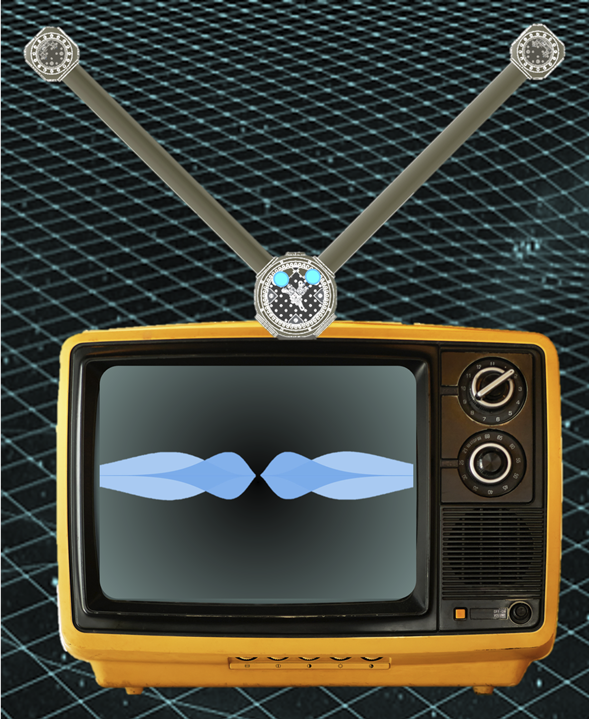
The Dark Matter TEsts using LEVItated Sensor Interferometer Observatory Network (DM Television) is a gravitational wave (GW) detector which uses optically levitated microparticles as resonant sensors for sensing small variations in the spacetime curvature. Previously, LIGO has detected these variations in spacetime occurring at frequencies from 10 Hz to few kHz. Those “ripples” in spacetime were generated typically by two compact objects (black holes or neutron stars) inspiraling around each other and eventually colliding.
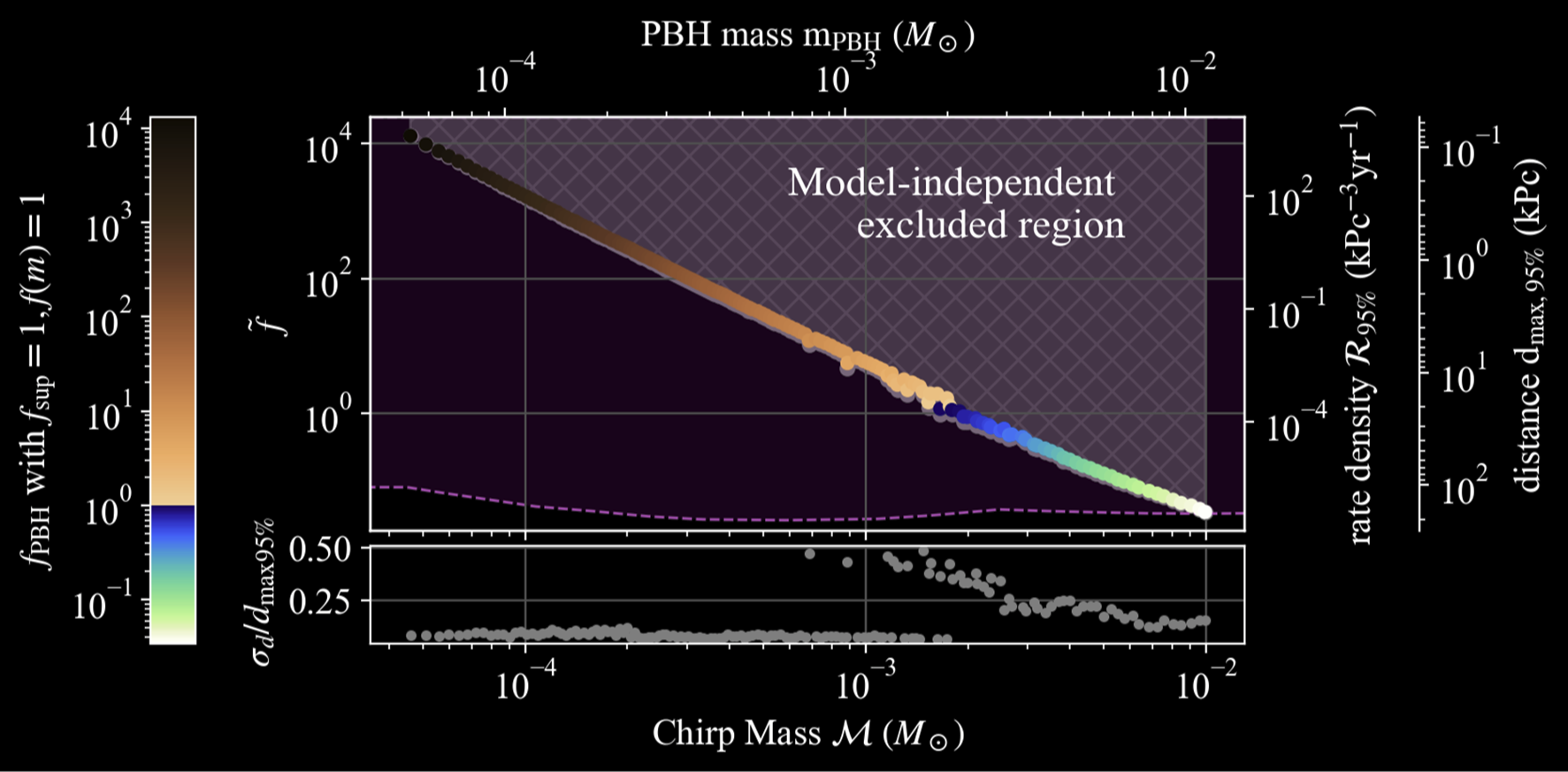
The upcoming LISA satellite observatory will look for similar GWs at lower frequencies. However, this leaves an unexplored region at higher frequencies. Novel sources such as sub-solar mass primordial black holes, as well as gravitationally bound states of the QCD axion, formed via black hole superradiance, may reside here. This project aims to explore that region, from 10 kHz, up to a few hundred kHz.
The UC Davis detector is part of a two-node observatory network, similar to LIGO Hanford and Livingston, with the other node at Northwestern University.
Collaborators: Northwestern
Read more:
- Searching for New Physics with a Levitated-Sensor-Based Gravitational-Wave Detector
- Optical Trapping of High-Aspect-Ratio NaYF Hexagonal Prisms for kHz-MHz Gravitational Wave Detectors
- Simulating the Galactic population of axion clouds around stellar-origin black holes: Gravitational wave signals in the 10–100 kHz band
ARIADNE Experiment
The Axion Resonant InterAction DetectioN Experiment (ARIADNE) looks for the QCD axion mediating a spin-dependent force between a mass and a spin. The QCD axion is one of the leading candidates for dark matter , primarily because it also solves an unrelated problem in particle physics, the Strong CP problem.
ARIADNE is searching for a new force mediated by the QCD axion. This force couples a spin
and mass via an effective magnetic field that depends on the separation between the mass and spin.
Therefore, a periodic change in the separation will modulate this effective
magnetic field. 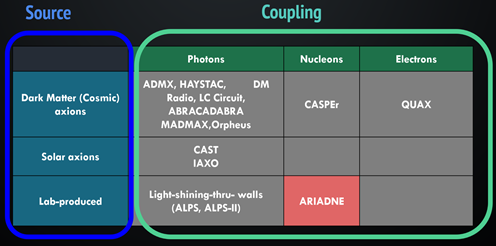 This
modulation can be measured via nuclear magnetic resonance (NMR); i.e. preparing the spin in a
constant magnetic field and modulating the effective field in a transverse direction perpendicular
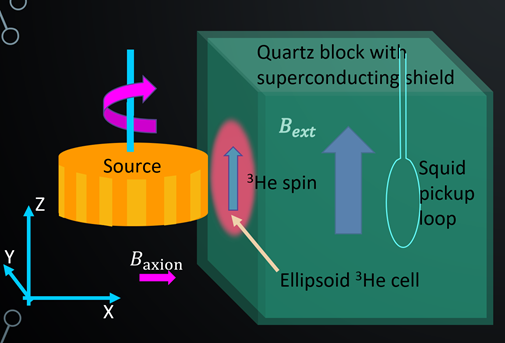
to the bias field. We use a tungsten rotor as the source mass, and hyperpolarized 3He gas as a spin ensemble in this
experiment. As the tungsten source mass rotates, the mass (and hence the magnetic field) seen by
the 3He spins gets modulated. If this modulation occurs at the Larmor frequency, the spins
acquire a slight transverse magnetization, which we then pick up via a SQUID.
Collaborators: Northwestern, Stanford, University of Illinois Urbana-Champaign, PTP, Tennessee Tech
Read more:
LIGO
Aggarwal did her PhD on quantum optomechanical squeezing for GW detection with the LIGO group. At this time, the group is involved in innovating new methods to look for dark matter using the LIGO detector.
Collaborators: LIGO VIRGO KAGRA (LVK) Collaboration
Read more:
PBH Search:
- Gravitational Wave Constraints on Planetary-Mass Primordial Black Holes Using LIGO O3a Data
- Method to search for inspiraling planetary-mass ultracompact binaries using the generalized frequency-Hough transform in LIGO O3a data
- Constraints on planetary and asteroid-mass primordial black holes from continuous gravitational-wave searches